Wednesday, February 29, 2012

The Jurassic Sea: The Most Dangerous Place for Me

The Jurassic seas are probably one of the most dangerous seas of all time. Now the dinosaurs may have been pretty big on land, but the only things that could outweigh them were the animals underwater.

Now we start out with one large, meat-eating land carnivore called eustreptospondylus. They were about as big as a giraffe. Now these animals aren't as big as t-rex, probably not even as big as an allosaurus. Maybe bigger maybe not.

But let me tell you something, these carnivores would still eat plenty of food. And I don't know, maybe one small, juicy, rhamphorhynchus. Rhamphorhynchus are these small pterosaurs. They may be a bit small but they're worth the fight.

 But now we will talk about the underwater world. Now underwater: one huge enormous reptile is about to strike. The reptile is called liopleurodon. The liopleurodon is the biggest meat-eater that ever lived. And this large predator is about to strike the ophthalmosaurus. The ophthalmosaurus is in the ichthyosaur family. And they have good night vision probably because of eyes the size of softballs. But even with those softball sized eyes, they won't be able to see the enormous, monstrous liopleurodon who is about to strike.

But wait a second, liopleurodon sees another animal. It's called hybodus, a very small shark but it lived for quite a long time. These creatures survived from the Permian period to the Cretaceous. But even the small hybodus will never be able to fight the liopleurodon. Liopleurodon eat sharks like we eat fish. Well we do eat sharkfin soup. And the shark takes its last look and then WHAM! the shark gets eaten.

But what's in the shadow over there? It's the largest fish ever. It's called leedsichthys. It's a pretty slow swimmer and it's a very, very, vulnerable animal. One of them has fallen behind and it's getting eaten alive by some hybodus and a marine crocodile called metriorhynchus. Metriorhynchus is one of your stranger crocodiles. It's like the leedsichthys is getting mosquito bites. Eventually leedsichthys will die. 8 hours later, now leedsichthys is dead. And now the liopleurodon are snacking on that humungous leedsichthys.

And well well looky here it's the ophthalmosaurus and he's trying to make a snack out of these ammonites. Ammonites are related to today's nautilus. Now imagine it as a unpoppable ballon. and when it is poppable, it will squirt out the air, which is the ink.


(image of Eustreptospondylus from walkingwith.wikia.com)
(image of Rhamphorhynchus from kidsdinos.com)

 (image of Liopleurodon from seamonsters.wikia.com)

 (image of Opthalmosaurus from http://www.abc.net.au)

(image of Hybodus from http://www.abc.net.au)

(image of Leedsichthys from bbc.co.uk)

(image of Metriorhynchus from bbc.co.uk)

(image of an ammonite from fossilmoldsandreplicas.com)
Sunday, February 26, 2012

How Smart are Animals

Animals are actually very very smart. There was once a dog that was so smart, that he knew the name of every single toy that he had and there were like a 1,000 toys. And even when he got a new toy, he would still know it. Perhaps a new chew toy of Einstein?

And dolphins are also very smart. There is one pod of dolphins that are very very smart. You may think a beach with not many underwater objects would be a paradise for dolphins, but really it is a tough place for dolphin survival. Now since fish are pretty small they can go in really shallow water. Dolphins can't really swim in shallow water, they are the size of a human. Well, they can skim across the water. Its quite dangerous and they could get trapped. It is a quite risky mission.

And you may think that not much brain power comes out of a mollusk, well actually it does. You know how much brain power it takes with those cells that change color?  Well it take a lot of brain power to do that. And some people say that things like cuttlefish can't change in any colory patterns. Well actually they kind of can. One time some people experimented to see if a cuttlefish can change to the checkered colors of a chess board. And you know what, it did work! The cuttlefish did make the back and white pattern. It wasn't exactly camouflage, but it got the job done.

Monday, February 13, 2012

Gray Wolf

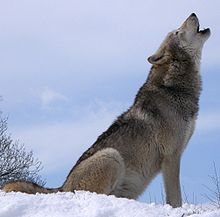
The gray wolf is an amazing predator. In fact, they were one of the few animals to survive the Ice Age. But there's this bigger wolf that didn't make it, called the dire wolf. Here's how the big ones did not survive and the smaller ones did.

The dire wolf was eating the really big prey. And the bigger the creature is, the harder it is for that creature to evolve. And the really big prey was disappearing.

Meanwhile the gray wolf was feeding on small things like rabbits and moles. So that's how the gray wolf survived.

And the gray wolf can run pretty fast. And it has this special pace where it can run very far. When it isn't in its pace and it's just sprinting, it can run 40 mph. And when its in its marathon runs, it can run up to 18 mph.
Us humans can run up to 23mph, so the gray wolf can run faster than a human when it's in sprinting mode. And anyway, a human can't run as far as a gray wolf.

Now wolves hunt in packs. The more wolves in a pack, the bigger prey they can take down. But the biggest and hardest to eat is the Moose. Moose can run 35 mph, but they can not run as long. But the moose's weapon is the horns. But they only work on one wolf. But the moose can swim.

Here's how you can tell if the paw prints are really gray wolf's. The gray wolf's paw prints are much bigger than a coyote's or a fox's.

(photo from en.wikipedia.org)