Showing posts with label prehistoric. Show all posts

Wednesday, February 29, 2012

The Jurassic Sea: The Most Dangerous Place for Me

The Jurassic seas are probably one of the most dangerous seas of all time. Now the dinosaurs may have been pretty big on land, but the only things that could outweigh them were the animals underwater.

Now we start out with one large, meat-eating land carnivore called eustreptospondylus. They were about as big as a giraffe. Now these animals aren't as big as t-rex, probably not even as big as an allosaurus. Maybe bigger maybe not.

But let me tell you something, these carnivores would still eat plenty of food. And I don't know, maybe one small, juicy, rhamphorhynchus. Rhamphorhynchus are these small pterosaurs. They may be a bit small but they're worth the fight.

 But now we will talk about the underwater world. Now underwater: one huge enormous reptile is about to strike. The reptile is called liopleurodon. The liopleurodon is the biggest meat-eater that ever lived. And this large predator is about to strike the ophthalmosaurus. The ophthalmosaurus is in the ichthyosaur family. And they have good night vision probably because of eyes the size of softballs. But even with those softball sized eyes, they won't be able to see the enormous, monstrous liopleurodon who is about to strike.

But wait a second, liopleurodon sees another animal. It's called hybodus, a very small shark but it lived for quite a long time. These creatures survived from the Permian period to the Cretaceous. But even the small hybodus will never be able to fight the liopleurodon. Liopleurodon eat sharks like we eat fish. Well we do eat sharkfin soup. And the shark takes its last look and then WHAM! the shark gets eaten.

But what's in the shadow over there? It's the largest fish ever. It's called leedsichthys. It's a pretty slow swimmer and it's a very, very, vulnerable animal. One of them has fallen behind and it's getting eaten alive by some hybodus and a marine crocodile called metriorhynchus. Metriorhynchus is one of your stranger crocodiles. It's like the leedsichthys is getting mosquito bites. Eventually leedsichthys will die. 8 hours later, now leedsichthys is dead. And now the liopleurodon are snacking on that humungous leedsichthys.

And well well looky here it's the ophthalmosaurus and he's trying to make a snack out of these ammonites. Ammonites are related to today's nautilus. Now imagine it as a unpoppable ballon. and when it is poppable, it will squirt out the air, which is the ink.


(image of Eustreptospondylus from walkingwith.wikia.com)
(image of Rhamphorhynchus from kidsdinos.com)

 (image of Liopleurodon from seamonsters.wikia.com)

 (image of Opthalmosaurus from http://www.abc.net.au)

(image of Hybodus from http://www.abc.net.au)

(image of Leedsichthys from bbc.co.uk)

(image of Metriorhynchus from bbc.co.uk)

(image of an ammonite from fossilmoldsandreplicas.com)
Friday, January 6, 2012

Megalodon vs. Prosqualodon

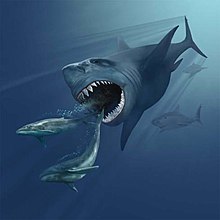
Alright, this is another prehistoric one - or more like two posts in one. A couple million years ago when our ancestors were becoming less ape-like and in fact a whole new animal form, Australopithecus --well we're talking about what was happening under water. Now you know that old great white shark, well millions of years ago about when the Australopithecus was roaming the earth, under the water was a shark called megalodon. And this enormous shark was bigger than today's great white. In fact, it was the size of a Greyhound bus. There was a rival, much smaller than it. The rival is called prosqualodon. Now it is much small than a megalodon. Alright, here we have the fight in action. Now first we have a megalodon swimming through the sea, minding its own business, but then comes a small prosqualodon. Then the ginormous megalodon attacks the prosqualodon. But the prosqualodon hunts in packs, so there are many more prosqualodons. And the other prosqualodons start biting at the megalodon's gills. Now the one prosqualodon might have been killed, but look at megalodon. He's got quite a few scars, too. And the picture may look like a dolphin, but believe me that is the prosqualodon.

(image of megalodon from en.wikipedia.org)

(image of prosqualodon from blogevolved.blogspot.com)

Tuesday, January 3, 2012

Spinosaurus

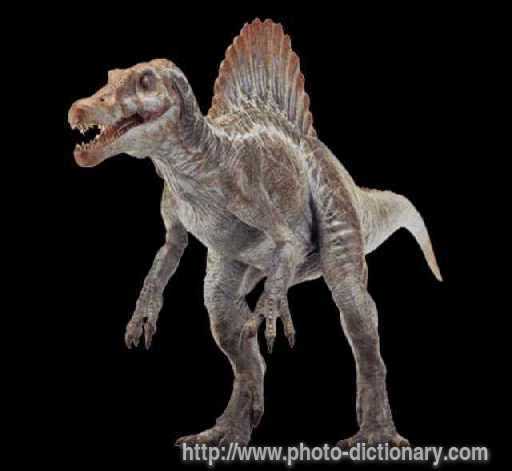
All right, everybody says, "T-Rex is the biggest land carnivore" well, there's a couple things bigger than it. Like the ginormous giganotosaurus (and it's a land carnivore too). And there's even bigger than giganotosaurus: there's carcharodontosaurus. But the biggest of all is the spinosaurus! It's called that because it has a sail with some spreaded out skin and spines. It could be for many things - a fishing lure, a use to stay cool, or maybe to look cool. And here's its big weapon: its enourmous claws. Oh yup, it can do some bad damage to its rivals. And here's another thing about it, it has unusual teeth. Compared to T-Rex, the spinosaurus' teeth are shaped like cones while T-Rex's are shaped like steak knives.

(image from photo-dictionary.com)

Therizinosaurus

The therizinosaurus - because of the "saurus" part, this is not an animal from today. In fact, it's a dinosaur. The therizinosaurus breaks the record for longest claws of the dinosaurs. And this is a herbivore - but it walks on 2 legs like most carnivore dinosaurs do. All right well, here's the difference between omnivores, herbivores, and carnivores: carnivores usually have 2 legs and most 2-legged dinosaurs eat meat. Some of them that have 2 legs can also be omnivores though. Omnivores can eat both meat and plants, but usually they mostly eat meat. Herbivores: they usually have 4 legs and eat plants. The therizinosaurus was actually a herbivore - scientists were amazed by that. And another way it looks pretty weird is how it has pot belly.

 (image from blog.webosaurs.com)

Monday, December 26, 2011

Coelacanth

The coelacanth is a very old creature. It came before the dinosaurs in a period called the Devonian. It went from that age all the way to this age. A long time ago people used to think they all died out. But some people found a coelacanth off the coast of South Africa, which proved that they still roamed the waters off of Africa.

(photo from bbc.co.uk)