Showing posts with label predator. Show all posts

Friday, February 3, 2012

Food Chain Lane

In this blog post I will be talking about the African food chain.

Ok, I'll start out around the very bottom of the African food chain: the grain of grass. Most herbivores in the Savannah eat grass. And they also like to eat Acacia trees. The Acacia tree is the logo for the show "Nature," so these Acacia trees are pretty much famous.

Well what's higher on the food chain are the herbivores like harvester termites and gazelle. Here are some facts about those 2 creatures. The Thompson's gazelle can run up to 50 miles per hour. And here are 2 facts about the harvester termite. The harvester termite isn't like the one that builds ginormous towers. They're a bit like ants, they live in holes. And here's another fact about those harvester termites: all the harvester termites in one tower could eat more grass than all the other herbivores. Because hey, it's like tiny mighty!


Now what eats harvester termites and what eats Thompson's gazelle? Well bat eared foxes would probably like to eat the termites. And if a gazelle is wounded it would be vulnerable to the python. Here are some facts about these 2 predators. The bat eared fox can hear termites through ground. And pythons are constrictor snakes - that means they have a very tight squeeze. That's their way of killing their prey: squeezing them to death. But believe it or not, we're not at the higest part of the food chain.

We need to go to the top predators. There's only one top predator in Africa: the lion. The lion fact is they may not be able to sprint very well but they are good at tackling. So what did you learn from this blog post? Well, you learned that a herbivore eating grass is no worse than a lion eating zebra.


Acacia Tree
(Photo from parsha.blogspot.com)

 African Grass
(Photo from anthonymattox.com)
Gazelle
(Photo from awf.org)
Termites
(photo from remotecamera-sa.blogspot.com)
Python
(photo from arkive.org)
Bat Eared Fox
(photo from arkinspace.com)

Lion
(photo from razorianfly.com)


Sunday, January 22, 2012

Tylosaurus and Others

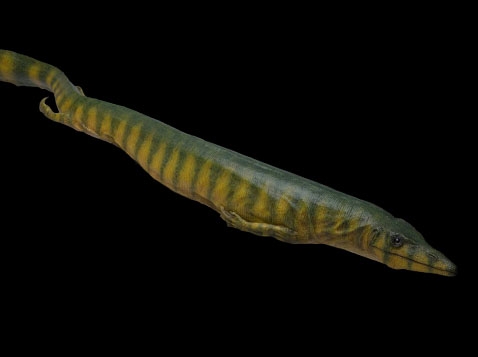
The Tylosaurus was top predator of the underwater Cretaceous. Now here is what this extremely powerful, monstrous, killing machine evolved from: believe it or not it evolved from these super small lizards that were trying to escape the dinosaurs in the Jurassic. And the lizard's only defense was to escape into the water and eventually it evolved to be built for the water. And the creature evolution just made was called Dallasaurus. And when did it evolve? The early Cretaceous.

When the late Cretaceous came, which was the time all the dinosaurs died out probably because of an asteroid, Tylosaurus became a fearsome predator. Probably because of its little special weapon: its teeth. The teeth point back into the mouth, so the only way the prey can go to escape is into the Tylosaurus, but it is hard for it to go inside. It has roof mouth teeth so it can hold the prey in place. Now there are many different types of Tylosaurus, but all of them are related to the snake. The Tylosaurus' future relative is the snake.

Now not all Tylosaurus are the biggest of predators. There is a small one called Platecarpus. And what makes it strange is that it has webbed feet, rather than fins. But Tylosaurus had some fearsome rivals. Now one of them is called the Ginsu Shark, also known as Cretoxyrhina. But Tylosaurus thinks the Ginsu Shark is an easy meal, even though the Ginsu Shark is even bigger than the sharks of today. But here is a really, kind of easy to munch meal. It's called Tusoteuthis, an enormous squid, probably related to today's colossal squid. Another rival of the Tylosaurus is called Squalicorax, another shark. Probably not as big as the Ginsu Shark, but believe me, the Squalicorax  is quite a predator.


(Photo from animals.nationalgeographic.com)
Tylosaurus a.k.a. Mosasaurs
  (Photo from chicospinosaurus.blogspot.com)
Dallasaurus
(Photo from animals.nationalgeographic.com)
Platecarpus
(Photo from animals.nationalgeographic.com)
Squalicorax
(Photo from animals.nationalgeographic.com)
Tusoteuthis
(Photo from animals.nationalgeographic.com)
Cretoxyrhina a.k.a. Ginsu Shark

Here are some videos!


Saturday, January 21, 2012

The Great White, Remoras and Orcas

In this post we will be talking about the famous great white shark and the great white's little helper, remora. Now, remoras look like parasites to us humans. But really, remoras are the opposites of pests, they actually eat the pests. From millions of years from evolution, the remora kind of looks upside down when they are right side up. It might be because of its suction head. Remoras latch on to sharks while they have suction cups on their head. The great whites and other sharks don't usually eat remoras. There's also this other kind of fish that cleans the shark's teeth.

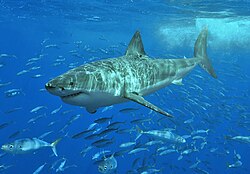
Now we will talk about the shark or rather the great white shark. The great white shark is a living torpedo. No really, its like a cruise missile (the cruise missile is a very powerful weapon). Now you may think those ol' great white sharks are super bulky to catch up to a seal lion, but actually the great white shark has amazing agility. In fact they sometime leap out of the water with the prey still in its mouth.

Now you may think that no one would mess with a great white shark, but really there are two predators that will mess with the great white. The creature is called the orca, also known as killer whale, but really its a dolphin. Most people call it a whale. And people call it a killer whale. Instead they should call it a killer dolphin. Now orca whales pretty much hunt in packs, but the great white shark can dive deeper. And here's the other predator of the great white... US HUMANS! Some people like to make shark fin soup out of them. And the worst thing us humans do: we hunt them for sport. Sport! That means really getting nothing out of it. Its just killing. And there may be less sharks than they think, because no one great white shark looks the same. On the plus side we have been putting tags on them.


(Photo from deeptypeflow.blogspot.com)
(Photo from marinebio.org)

(Photo from en.wikipedia.org)

Friday, January 6, 2012

Megalodon vs. Prosqualodon

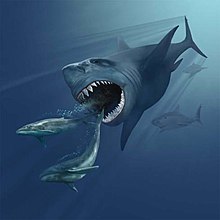
Alright, this is another prehistoric one - or more like two posts in one. A couple million years ago when our ancestors were becoming less ape-like and in fact a whole new animal form, Australopithecus --well we're talking about what was happening under water. Now you know that old great white shark, well millions of years ago about when the Australopithecus was roaming the earth, under the water was a shark called megalodon. And this enormous shark was bigger than today's great white. In fact, it was the size of a Greyhound bus. There was a rival, much smaller than it. The rival is called prosqualodon. Now it is much small than a megalodon. Alright, here we have the fight in action. Now first we have a megalodon swimming through the sea, minding its own business, but then comes a small prosqualodon. Then the ginormous megalodon attacks the prosqualodon. But the prosqualodon hunts in packs, so there are many more prosqualodons. And the other prosqualodons start biting at the megalodon's gills. Now the one prosqualodon might have been killed, but look at megalodon. He's got quite a few scars, too. And the picture may look like a dolphin, but believe me that is the prosqualodon.

(image of megalodon from en.wikipedia.org)

(image of prosqualodon from blogevolved.blogspot.com)

Wednesday, January 4, 2012

Proboscis monkey

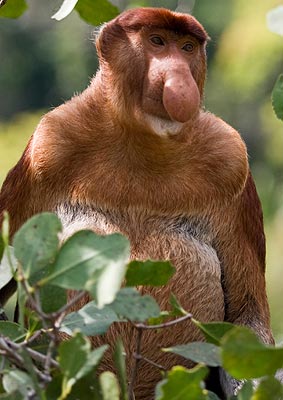
Here's an amazing thing about the proboscis monkey: the leader of the herd searches for danger and when it finds danger, with a blow of its big old nose, it'll tell the herd to run away. And the honk that it does with its nose is called "the core honk." And here's an extremely amazing AND rare thing about these monkeys: they have webbed feet which are useful for swimming away from its predator, the gharial (a relative of the alligator). Well here's how a gharial would probably get to its delicious proboscis monkey lunch: well, you see, if the monkey is in water, that is just one way of attacking. But you know how fast creatures like this can strike. So if one is maybe sort of just at a thin branch up, just over  a stream or something, then the gharial might be able to attack.

(photo from bestourism.com)
(photo from dinets.travel.ru)

Tuesday, January 3, 2012

Spinosaurus

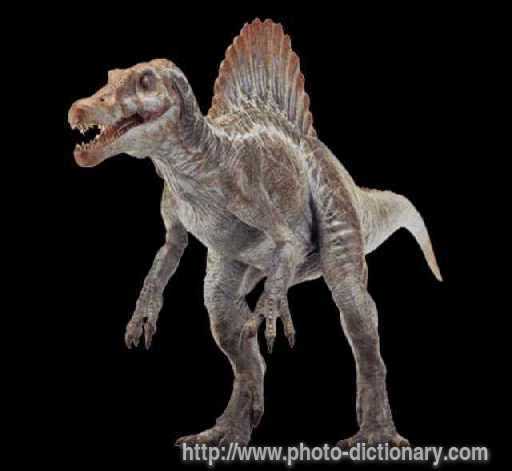
All right, everybody says, "T-Rex is the biggest land carnivore" well, there's a couple things bigger than it. Like the ginormous giganotosaurus (and it's a land carnivore too). And there's even bigger than giganotosaurus: there's carcharodontosaurus. But the biggest of all is the spinosaurus! It's called that because it has a sail with some spreaded out skin and spines. It could be for many things - a fishing lure, a use to stay cool, or maybe to look cool. And here's its big weapon: its enourmous claws. Oh yup, it can do some bad damage to its rivals. And here's another thing about it, it has unusual teeth. Compared to T-Rex, the spinosaurus' teeth are shaped like cones while T-Rex's are shaped like steak knives.

(image from photo-dictionary.com)